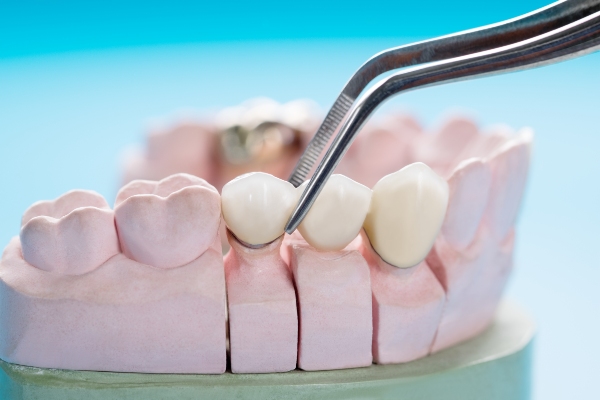
 Dental bridges help restore smiles and maintain oral health by replacing missing teeth. Understanding the different types of dental bridges can help you choose the right solution for tooth loss. The following blog covers the four main types of dental bridges and their features.
Traditional dental bridges
Traditional dental bridges are among the most common options for replacing missing teeth. These bridges consist of a false tooth—a pontic—held in place by dental crowns cemented onto the adjacent teeth. Dentists typically recommend traditional bridges when patients have healthy teeth on both sides of the gap.
The primary advantage of traditional dental bridges is their durability and strength. This makes them suitable for restoring molars and other teeth that endure everyday chewing and biting functions. However, the process requires reshaping the adjacent teeth to accommodate the crowns, which can permanently alter their structure.
Cantilever dental bridges
Cantilever dental bridges are similar to traditional bridges. However, they are supported by a dental crown on only one side. These bridges are mainly for when the patient only has only one natural tooth available next to the gap.
Cantilever bridges can provide an effective solution for replacing missing teeth. However, they are less stable than traditional bridges. Dentists typically do not recommend them for patients missing teeth in areas of heavy chewing pressure, such as the back molars.
Maryland bonded bridges
Maryland bonded bridges, also known as resin-bonded bridges, offer a conservative alternative to traditional bridges. These bridges consist of a pontic supported by a metal or porcelain framework. The dentist can bond this framework to the back of the adjacent teeth using a special adhesive.
The primary benefit of Maryland bonded bridges is that they do not require the dentist to prepare or alter the patient's adjacent teeth. This conservative approach makes them an ideal choice for individuals seeking a minimally invasive solution. However, Maryland bridges are less durable than traditional options and may not withstand the everyday wear and tear from chewing and biting food.
Implant-supported bridges
Implant-supported dental bridges are a stable, long-lasting solution for replacing multiple missing teeth. These bridges are anchored to dental implants surgically placed in the patient's jawbone. They provide a secure and natural-feeling restoration while improving the appearance of the patient's smile.
Unlike other types of dental bridges, implant-supported bridges do not rely on the surrounding teeth for support. This preserves the integrity of the surrounding teeth while maintaining the density of the patient's jawbone. However, it is important to remember that getting implant-supported bridges can be more time-intensive and costly. The process commonly requires two surgeries to embed the implant into the jawbone and another to place the bridge.
How to choose the right dental bridge
Choosing the best type of dental bridge depends on a variety of factors, including:
- The location of the missing teeth
- The number of missing teeth
- The state of bone and overall oral health
- The condition of the adjacent teeth
- Patient preferences
The dental professional can evaluate these factors and develop a treatment plan to fit each patient's unique needs and goals.
Learn more about dental bridges
Dental bridges are an effective way to restore the function and appearance of your smile after losing one or more teeth. Do you have questions for the Zen Dentistry Westchester team? Call our New Rochelle office to learn more about dental bridges or to schedule a consultation.
Request an appointment or call Zen Dentistry Westchester at 914-826-8363 for an appointment in our New Rochelle office.
Related Posts
You can have a complete smile with a dental bridge. Tooth loss interrupts proper eating and speaking. This dental replacement option allows the wearer to regain proper oral function. Knowing how a dental bridge can bring back your oral functionality can motivate you to set an appointment with your dentist soon.It can be challenging to…
Dental bridges and crowns are the two most popular smile restoration options, enhancing function and appearance. However, they vary in design, purpose, and care. Understanding how these solutions work and their differences can help patients make decisions during the restoration process.A dental bridge is a custom-made restoration that fills the gap left by one or…
A dental bridge is a tooth replacement option that does not require incisions to be made into the gums. However, there are many different types of dental bridges, and finding the perfect one can feel overwhelming. While your dentist will usually recommend what they think is best, it can be helpful to know the available…